
Why Adopting Technology is the Next Big Thing for Financial Professionals

Viral Bhatt
Founder - Money MantraArticle

Why
Adopting Technology is the Next Big Thing for Financial Professionals
The financial advisory profession is standing at an inflection point.
Markets are volatile. Regulations are evolving. Clients are more informed — and
more impatient — than ever before. In this environment, adopting technology is
not a luxury. It is the next big strategic shift for financial professionals.
The question is no longer “Should we adopt technology?”
The real questions are — Why now? What exactly should we adopt? And how do we
implement it intelligently?
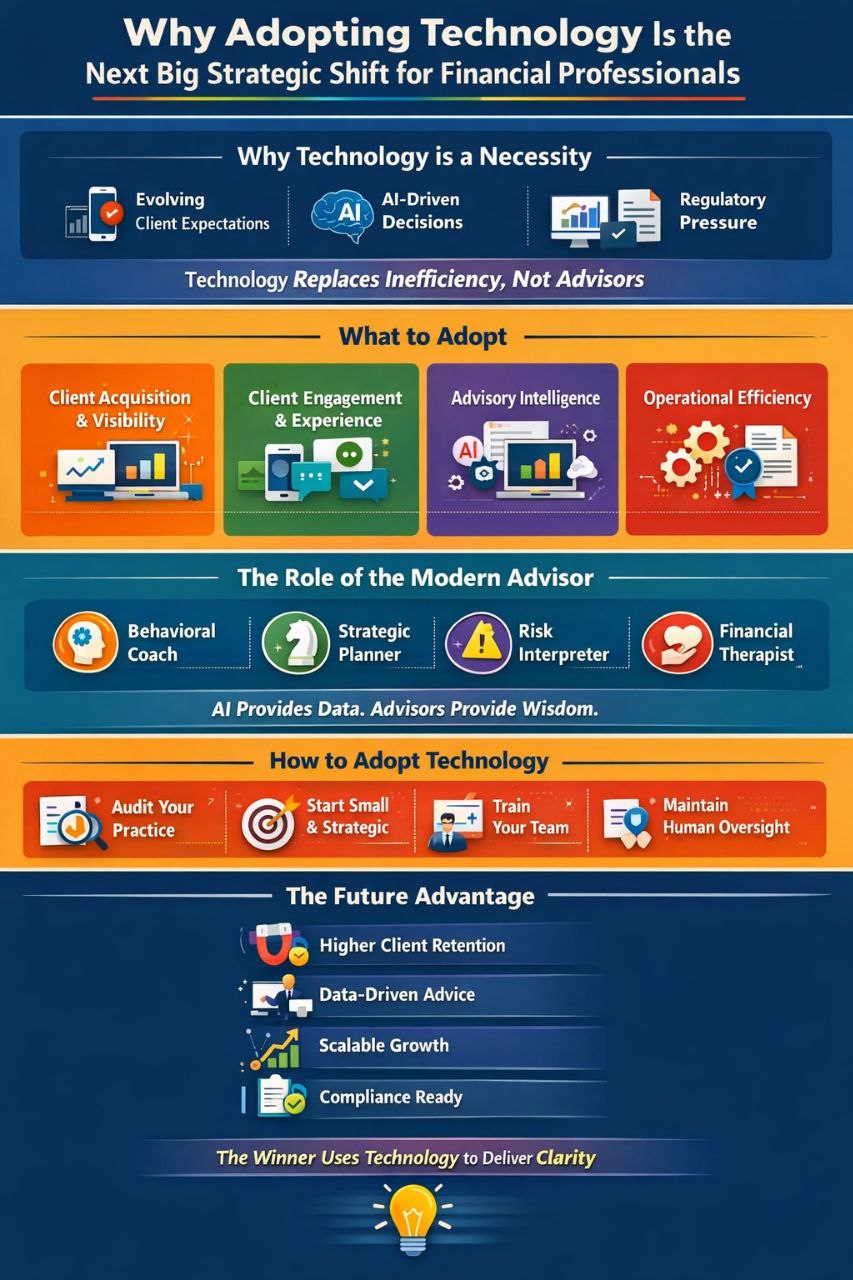
WHY: Because
Client Expectations Have Changed Forever
Today’s investor lives in the era of instant UPI payments, real-time portfolio
tracking apps, AI-driven recommendations, and digital KYC in minutes. If
clients can order groceries in 10 minutes, they expect portfolio insights
instantly.
Investment platforms and fintech companies have redefined convenience. Even
traditional financial institutions are investing heavily in digital interfaces.
If financial professionals don’t match this experience, clients will migrate
toward those who do.
But here’s the important insight:
Technology is not replacing advisors.
Technology is replacing inefficient advisors.
WHY: Because
AI Is Changing Decision-Making
Artificial Intelligence is not just about chatbots. It is about data-driven
portfolio analytics, risk profiling based on behavioral patterns, automated
rebalancing alerts, predictive cash-flow planning, and scenario simulation.
Imagine showing a client:
“If inflation stays at 6%, your retirement corpus will fall short by ₹42
lakhs.”
“If you delay SIP by 5 years, your wealth reduces by 37%.”
AI-powered tools can model this in seconds.
This shifts advisors from being product distributors to becoming financial
strategists.
WHY: Because
Regulation and Compliance Are Tightening
With tighter regulatory frameworks, documentation, suitability, and audit
trails are becoming non-negotiable.
Technology helps with digital documentation, automated compliance checklists,
risk categorization logs, communication archiving, and transaction tracking.
The advisor who uses tech becomes audit-ready by default.
WHAT: What
Technology Should Financial Professionals Adopt?
Adopting technology does not mean blindly subscribing to every new AI tool. It
means adopting strategically across four pillars.
1. Client Acquisition & Visibility
LinkedIn branding, digital webinars, automated email funnels, and AI-powered
content generation are powerful tools. Clients Google you before they meet you.
Your digital presence is your new visiting card.
2. Client Engagement & Experience
WhatsApp Business automation, portfolio dashboard apps, AI-based meeting
summaries, and goal-tracking interfaces improve professionalism and trust.
After a review meeting, imagine the client automatically receiving summary
notes, action points, and updated projections. That builds confidence.
3. Advisory Intelligence (AI Layer)
AI can assist in asset allocation simulations, Monte Carlo retirement
projections, stress-testing portfolios, tax optimization alerts, and behavioral
risk flags.
Instead of spending hours building Excel sheets, advisors can focus on
understanding the client’s fears, goals, and behavior.
Technology handles calculation.
Advisors handle judgment.
4. Operational Efficiency
CRM systems, automated SIP tracking, renewal reminders, revenue analytics, and
GST reconciliation tools transform chaos into systems. Systems create
scalability. Scalability creates enterprise value.
The Role of Financial
Advisor in the AI Era
Many professionals fear that AI will replace them. The reality is different.
AI will replace execution.
It will not replace empathy.
Money decisions are emotional — fear of loss, greed during bull markets, panic
during corrections, family pressure, and social comparison.
During market crashes, clients don’t call an app. They call a human.
The advisor’s role evolves into a behavioral coach, financial therapist,
strategic planner, risk interpreter, and accountability partner.
AI provides intelligence.
Advisors provide wisdom.
HOW: How Financial Professionals Should Adopt Technology
Adoption must be phased and strategic.
Step 1: Audit Your Current Practice
Identify where time is wasted, which processes are manual, where errors happen,
and what clients complain about. Technology should solve friction — not create
complexity.
Step 2: Start Small but Strategic
Do not implement 20 tools at once. Start with a CRM system, portfolio analytics
software, AI content assistant, and digital meeting documentation. Master a few
tools deeply.
Depth beats distraction.
Step 3: Train the Team
Technology without training creates resistance. Conduct workshops on AI usage,
data privacy, digital compliance, and workflow systems. The team must see
technology as empowerment, not threat.
Step 4: Maintain Human Dominance
Never let AI handle critical client advice independently. Use AI for drafting,
analysis, simulation, and efficiency — but final advice must carry human
responsibility.
Trust cannot be outsourced.
The Strategic Advantage
Advisors who adopt technology early will enjoy higher client retention, faster
onboarding, data-backed advice, scalable revenue, and higher enterprise
valuation.
In the coming years, the industry will split into tech-enabled advisory firms
and struggling traditional intermediaries. The gap will widen significantly.
Final Thought
The future financial professional is digitally visible, AI-enabled,
behaviorally intelligent, process-driven, and compliance-ready.
Technology is not the enemy of advisory practice.
It is the multiplier.
Adopt it thoughtfully.
Integrate it strategically.
Lead with humanity.
Because in the future of finance —
The winning advisor will not be the one who knows the most products.
It will be the one who uses technology to deliver the most clarity.
Discussion
4